 |
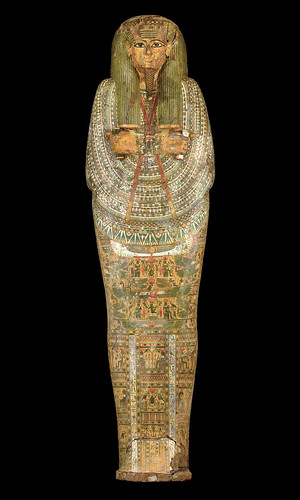
| This Dynasty XXI sarcophagus is made from sycamore fig-wood with colorfully painted scenes. |
The front lid of Neshkons' sarcophagus is truly a marvel of ancient Egyptian art. Proudly acquired by the Merrin Gallery, it depicts the deceased in mummiform, surrounded by various goddesses, mystical creatures, and many other painted scenes commemorating Neshkons' life and wishing well for his afterlife.
Purchased when it went up for auction at Christie's in 2006, Samuel Merrin, owner of the Merrin Gallery on New York's Fifth Avenue, recollects that, “We were prepared to pay three times the price we eventually paid, because we recognized its beauty and rarity. We also knew that this would be known as the most prized acquisition at the auction.”
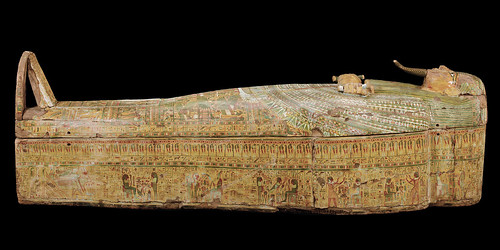 |
| The right side of both the lid and trough of Neshkons' sarcophagus features varying scenes of ancient Egyptian funerary art with hyerogylphic inscriptions; further detailed on Sam's Flickr. |
The Merrin Gallery's sarcophagus comprises of a lid, trough and the mummy of Neshkons. It was, and still is regarded as a record bid for a sarcophagus and mummy.
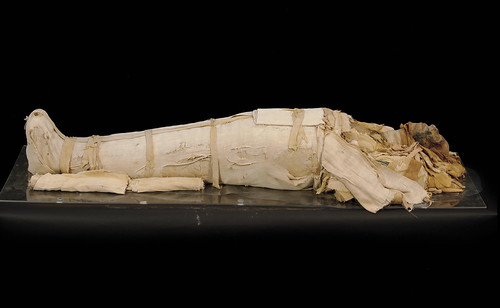 |
| Burried sometime between 900–940 BC, the sarcophagus of Neshkons was excavated in 1900 AD and later shipped from the Egyptian Museum in Cairo to the Western Reserve Historical Society in Cleveland, Ohio, where the mummy was partially unwrapped. |
According to Samuel Merrin's appraisal, “The preservation of the mummy is excellent.”
 An x-ray image of the mummy shows us that a metal plate that was placed over an incision by which his internal organs were removed for ceremonial funerary purposes. The x-ray of Neshkons' mummy, and analysis thereof, also helped determine that he died at 20 years of age.
Mr. Merrin reminds us that, “It is one of the best sarcophagi from the best period — the 21st dynasty.” This is evident as the inside and outside of the sarcophagus display wonders of ancient Egyptian art.
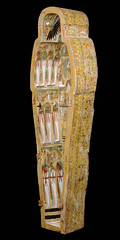
The inside walls of the Merrin sarcophagus are similar in that they depict the Four Sons of Horus and Anubis
Speaking to Samuel we discover that, “Judging from the elaborate sarcophagus and the amulets founds under the wrappings, Neshkons must have been a man of high rank and repute.” His coffin is decorated with gods, goddesses and notable figures in ancient Egyptian society (e.g. Amenhotep I).
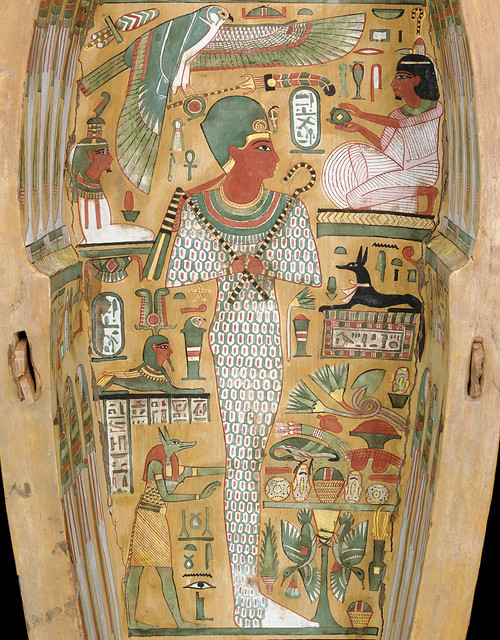 |
| Among the many other figures, the inside of Neshkons' sarcophagus features a small sphinx to the left of the central figure (Amenhotep I), below which is a standing Anubis. To the right of the Anubis is a table of offerings, and above that there is a small black figure — Anupet, the female Anubis. |
After Mr. Moshe Bronstein of the Merrin Gallery put down his auction paddle after the winning bid, another dealer was said to have exclaimed that it was a great purchase and asked to buy a half-share of the sarcophagus.
“Buying a half-share is common among dealers, but we did not need to bring in any partners. We wanted to be the sole owners of this magnificent sarcophagus. We also knew that its provenance was perfect,” Samuel Merrin concludes.
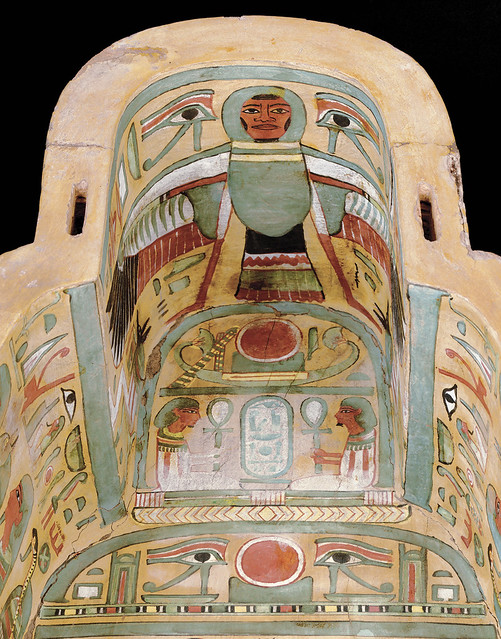 |
| The inside-top part of the Merrin Gallery's sarcophagus features hieroglyphic inscriptions, seated jackal deities, as well as a Ba-bird, Anubis, and Ipt. |


