Showing posts with label Merrin Gallery. Show all posts

May 21, 2012

Neskhons' Heart Scarab & Ba-Bird

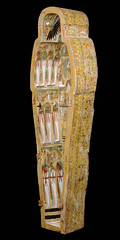
Beautiful detail inside Neskhons' sarcophagus.
Part of a large, ancient Egyptian sarcophagus acquired and sold by the Merrin Gallery, Neskhons' mummy was accompanied by the traditional amulet and falcon pendants. While dwarfed by the size of the sarcophagus and the elaborate decoration, these items hold great significance.

The amulet, called a "heart scarab", is a large, beetle-shaped object, usually of green stone or faience, that was placed over the heart of the deceased.

Its form is significant. Because the larvae of the scarab beetle emerged from a ball of dung in which they incubated, it appeared as magical regeneration to the ancient Egyptians. It also came to represent the reappearance, each dawn, of the Sun and became associated with the god, Khepri.

Two falcons from Neskhons' tomb as well as the front and back view of the heart scarab - showing inscriptions
The two Ba-bird falcons with their wings spread and heart scarab were found on
Nekhons' mummy. The back view of the heart scarab reveals the inscription.

In rituals prescribed in "The Book of the Dead", the scarab was used in the "weighing of the heart ceremony", in which it was set upon a balance scale against a feather of truth, to determine the individual's fate in the afterlife. An inscription beseeches the heart scarab not to bear negative testimony.

November 8, 2011

The Great Merrin Sarcophagus

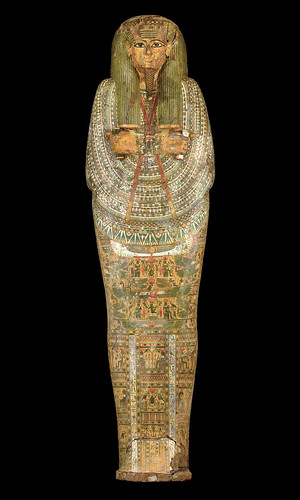
Ancient Egypt: The Merrin Gallery's Sarcophagus (Lid)
This Dynasty XXI sarcophagus is made from
sycamore fig-wood with colorfully painted scenes.
Art experts like Samuel Merrin consider this ancient Egyptian sarcophagus to be among the last great ones in private hands.

The front lid of Neshkons' sarcophagus is truly a marvel of ancient Egyptian art. Proudly acquired by the Merrin Gallery, it depicts the deceased in mummiform, surrounded by various goddesses, mystical creatures, and many other painted scenes commemorating Neshkons' life and wishing well for his afterlife.

Purchased when it went up for auction at Christie's in 2006, Samuel Merrin, owner of the Merrin Gallery on New York's Fifth Avenue, recollects that, “We were prepared to pay three times the price we eventually paid, because we recognized its beauty and rarity. We also knew that this would be known as the most prized acquisition at the auction.”
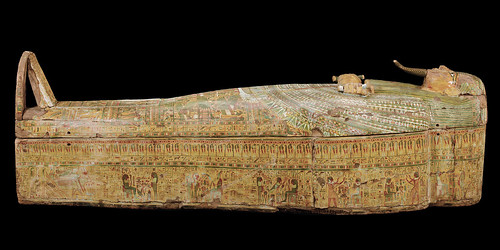
Htp-D'i-Nsw: The Merrin Gallery's Sarcophagus (Right Side)
The right side of both the lid and trough of Neshkons' sarcophagus features varying scenes of ancient Egyptian funerary art with hyerogylphic inscriptions; further detailed on Sam's Flickr.

The Merrin Gallery's sarcophagus comprises of a lid, trough and the mummy of Neshkons. It was, and still is regarded as a record bid for a sarcophagus and mummy.
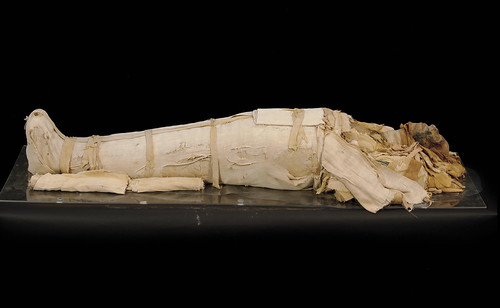
Neshkons' Mummy (Part of the Merrin Sarcophagus)
Burried sometime between 900–940 BC, the sarcophagus of Neshkons was excavated in 1900 AD and later shipped from the Egyptian Museum in Cairo to the Western Reserve Historical Society in Cleveland, Ohio, where the mummy was partially unwrapped.

According to Samuel Merrin's appraisal, “The preservation of the mummy is excellent.”

X-ray of Neshkons' Mummy (Part of the Merrin Sarcophagus)An x-ray image of the mummy shows us that a metal plate that was placed over an incision by which his internal organs were removed for ceremonial funerary purposes. The x-ray of Neshkons' mummy, and analysis thereof, also helped determine that he died at 20 years of age.

Mr. Merrin reminds us that, “It is one of the best sarcophagi from the best period — the 21st dynasty.” This is evident as the inside and outside of the sarcophagus display wonders of ancient Egyptian art.
Anubis & Sons of Horus on Sarcophagus (Inside-Left/Outside-Right)

The inside walls of the Merrin sarcophagus are similar in that they depict the Four Sons of Horus and Anubis with various other deities. As far as typography is concerned, a passage known as the htp-di-nsw with additional scripture is featured on both inner sides, but with slight variations. The outer right and left sides are also found to have subtle, intended differences in terms of hieroglyphic scripture, scenes and depictions.

Speaking to Samuel we discover that, “Judging from the elaborate sarcophagus and the amulets founds under the wrappings, Neshkons must have been a man of high rank and repute.” His coffin is decorated with gods, goddesses and notable figures in ancient Egyptian society (e.g. Amenhotep I).
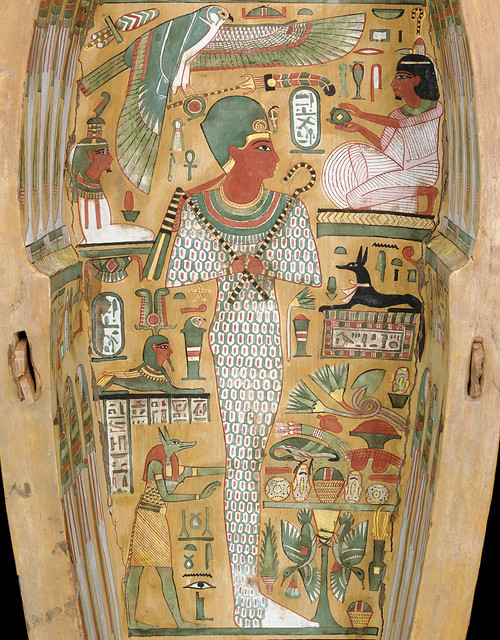
Sphinx & Anubis Inside the Merrin Gallery's Sarcophagus
Among the many other figures, the inside of Neshkons' sarcophagus features a small sphinx to the left of the central figure (Amenhotep I), below which is a standing Anubis. To the right of the Anubis is a table of offerings, and above that there is a small black figure — Anupet, the female Anubis. 

After Mr. Moshe Bronstein of the Merrin Gallery put down his auction paddle after the winning bid, another dealer was said to have exclaimed that it was a great purchase and asked to buy a half-share of the sarcophagus.

“Buying a half-share is common among dealers, but we did not need to bring in any partners. We wanted to be the sole owners of this magnificent sarcophagus. We also knew that its provenance was perfect,” Samuel Merrin concludes.
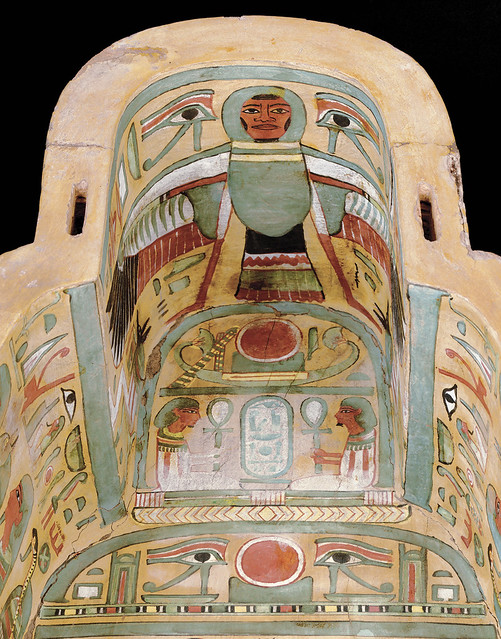
Ba-Bird in an Ancient Egyptian Sarcophagus
The inside-top part of the Merrin Gallery's sarcophagus features hieroglyphic inscriptions, seated jackal deities, as well as a Ba-bird, Anubis, and Ipt.

August 9, 2011

Egyptology – Funerary Shabtis of Ancient Egypt

The origin of the shabti in ancient Egyptian civilization is a debated issue. Nevertheless, by the time of Dynasty XII of the Middle Kingdom (about 1991–1782 BC), shabtis gradually become a fixed feature of the funerary panoply of elite members of Egyptian society.

“Contrary to popular opinion, these statuettes were not anciently regarded as servants who might magically attend to every whim of their owners. Rather, they were intended to serve as surrogates for both aristocrats and pharaohs of both sexes who were expected to respond to the roll call in the hereafter,” illuminates Samuel Merrin of the Merrin Gallery in New York.

Also known as an ushabti, the word “shabti” derives from the ancient Egyptian word for “the responder”. They were to perform specific work of an enigmatic nature which primarily entailed the cultivation of fields, the irrigation of the river banks, and “the ferrying of sand of the east to the west and vice-versa”.

February 4, 2011

Roundup: Past Few Merrin Months

Consolidating fall '10 and winter '10/11 at the Samuel Merrin & Gallery blog.


Notably includes a look at Samuel Merrin's professional work – through matters concerning clients of The Merrin Gallery. As well as Samuel's personal life – through an exploration of artistic favorites, and NGO-involvement. (Note that all articles have been updated since their original publication.)

RECENTLY ON THE SAMUEL MERRIN & GALLERY BLOG:


Samuel Merrin's Favorite Artwork

An article touching on one of Samuel Merrin's favorites pieces of art, included a rotating look the piece through a an all-around 360 video. A more detailed look at the piece itself, and the history behind can be expected on Samuel Merrin & Gallery shortly, but the article has been updated with a list of publications and detailed specifications of Samuel's vase.

Samuel Merrin & Confidentiality

An article detailing Samuel Merrin's buying practices and the handling of clients' privacy also (shortly) touched on, for example, his ability to buy back older collections. As well as The Merrin Gallery's competitive edge on auction houses like Sothebie's.

November 28, 2010

Video: The Merrin Gallery & Ancient Art

What is ancient art? The official YouTube Channel of the Merrin Gallery has recently gone public with a video featuring several objects of ancient art from Egypt, Rome and South America.

It is possible to view these antiquities on YouTube in extremely high definition (up to 1080p HD), or also below:


November 5, 2010

Roundup: Ancient Egypt, Greece and Sam Merrin

Renowned expert for pre-Columbian and ancient art, find out about Sam Merrin here, the owner and president of The Merrin Gallery, Inc.


Recent acquisitions of the Merrin Gallery include three fabulous pieces that have been discussed on this blog:
  1. Ancient, 2,500 year old Egyptian figurine
  2. Large decorated amphora from ancient Greece
  3. Beautiful wooden mask from an Egyptian sarcophagus

July 13, 2010

Large Ancient Greek Amphora with Herakles

A recent acquisition of the Merrin Gallery, this ancient Greek, black-figured amphora from Athens depicts the apotheosis of Herakles (the Greek name for Hercules). Quite simply a beautiful and very large Attic amphora, dated 520-510 B.C.

On the front it is decorated with Athena stepping into her quadriga and holding a spear, Herakles holding a club and bow, Dionysos holding vine branches, and Hermes leading the team. On the back it depicts Apollo Kitharoidos accompanied by a feline and flanked on either side by a goddess and satyr.

For a discussion of these figures, please visit the Merrin Gallery's page on this 2,500 year old Greek amphora.

Upon closer observation, there are inscriptions in the field, a palmette-and-lotus chain above each scene, rays above the foot, ivy on the sides of the handles, and the details have been added in red and white by the skillful and renowned Antimenes Painter.

July 9, 2010

Wooden Mask from Ancient Egypt

This very beautiful face mask comes from the inner coffin of a large ancient Egyptian sarcophagus, dated at around 1305-946 B.C. The red paint was painted over a layer of gesso and linen. Recently acquired by the Merrin Gallery, the broad oval face has a delicately carved mouth indented at the corners.


The lips are outlined and almost form a smile. The nose is straight with recessed nostrils. The eyes are set wide apart and the cosmetic lines are emphasized in black, which of course was the custom of the day, but also makes this ancient work of art very powerful. The face is very sensitive and the artist who sculpted it, over 3,000 years ago, was clearly a master artist.

Samuel Merrin presents another recently acquired, interesting ancient Egyptian piece. But for more information on this polychrome wooden mask, please visit the Merrin Gallery's website.

July 5, 2010

An Ancient Egyptian Shabti

In tune with Sam Merrin's recent comment in regards to Tutenkhamun's exhibition at the Met, the Merrin Gallery has acquired an ancient Egyptian piece from the 26th dynasty, dated 570-526 B.C., under the reign of Amasis II.

It is a shabti (funerary figurine) depicting the Wab priest to the King (his titles include: Royal Chancellor of Lower Egypt, Administrator of the Palace, son of Schepen-Bastet). The figure holds the traditional hoe, pick, and seed-sack.

The head, wearing a braided beard and striated tripartite wig, has a finely modeled face whose eyebrows and cosmetic lines are illustrated through relief. The faience body is embossed with eight lines of inscription.

Such shabtis of Neferibresaneith are among the most beautiful ones of the Late Period. The piece is made entirely from faience, a notable ancient Egyptian material.

The tomb of Neferibresaneith was found at Saqqara, south of the funerary complex of King Userkaf, in 1929, and was fully excavated in the late 1940s. In all, 366 shabtis were found, most of them resting on the lid of the stone sarcophagus under the carbonized wood box.

More information about the ancient Egyptian shabti of Neferibresaneith can be found at the Merrin Gallery.

Update: Another parallel acquisition of an ancient Egyptian artwork by the Merrin Gallery.

June 22, 2010

Samuel Merrin and the Gallery

To formally introduce, Samuel Merrin is the president and owner of The Merrin Gallery, Inc. Established in 1987, and while incorporated that year, it is a second-generation ancient art business founded by Sam's father, Edward Merrin in the mid-1960s. This came at a time when Ed started acquiring and selling pre-Columbian art—becoming an expert in the field.

Samuel formally took over the gallery in 1999 and has been involved with ancient art his entire life. As a child, Sam frequently visited his father’s gallery, and worked there over many summer vacations. He was fascinated by the beauty and telling history of the objects that he would handle. Inspired, Samuel received a BA from Tufts University, worked at The Cloisters museum and interned at 'the Met' in NYC.

Today, Sam Merrin is asked to give appraisals for identifying major pre-Columbian art and other ancient works—in terms of authenticity and value—for museum exhibitions, auction houses, dealers and other institutions. Sam has coordinated several major exhibitions, and published accompanying catalogues of objects for sale. He has been featured in several newspapers, art magazines, and TV programs for his antiquity know-how.

Samuel's expertise has been sought after for many major collections in America and Europe, where clients of the Merrin Gallery include leading museums such as The Metropolitan Museum of Art in NYC, the Louvre in Paris, the British Museum in London and the Middle East, as well as many others.

This blog aims to illuminate some of this work surrounding ancient art, as well as giving casual information for collectors and enthusiasts. We hope you will find it helpful and informative, and if you have any questions, then please leave a comment below, or the Merrin Gallery's Facebook page.

Recent Posts