Showing posts with label Samuel Merrin. Show all posts

December 6, 2011

Maya Jade Stone: God of Corn

The Maya society flourished in parts of Mexico and Central America from the late first millennium BC until the late first millennium AD. Its height, called the “Classic period”, spanned the years 300–900 AD. The Maya founded numerous city-states, each ruled by a lord and supported by a hierarchy of elite and common folk.

Face of the Young Maize God showing the preserved texture of the jade stone it was crafted from
Maya royal jade stone figure
of the Young God of Corn.

More Valuable Than Gold

As in any stratified society, Maya nobles enjoyed prerogatives denied to their underlings. One privilege was the wearing of precious ornaments that marked their elevated rank. In Maya society, jade was valued beyond all other materials, so the most desirable and expensive adornments were crafted of the hard, verdant stone. The scarcity of jade can be inferred by the frequent uneven edges or asymmetry of completed objects: rather than cut away the “excess” and waste it, the stone was finished to preserve as much jade as possible.

Maya at the Merrin Gallery

Two late Classic period royal jade pendants, acquired by Samuel Merrin for the gallery, are exquisitely carved in the form of human heads, each with its own embellishment of earspools (or perforated lobes for the addition of separately fashioned ear ornaments) and headdress. The leaf-like shape of the headdress elements allow us to identify the individuals represented as the Young Maize God. A similar jade head of a Maize God, though without the perforation that permits wearing, is in the collection of the Museum of the American Indian and can be seen in Linda Schele and Mary Ellen Miller's 1986 book, The Blood of Kings: Dynasty and Ritual in Maya Art (no. 560).

Profile of the Maya Young Maize God with elaborate detail and decoration in jade
A channel, perforated through the top
of each pendant, allowed it to be worn.
The variegated green tones of the jade stone make for a particularly appropriate medium to represent this deity — the verdant hue evoking all things green and flourishing. The compact, ovoid form is meant to suggest the seed corn that will produce the mature plant that is the basis of the Maya diet.

Origins: The Corn God

The Young Maize God began his mythic life as a mortal, Hun Hunahpu or Hun Hunahaw (literally, first first lord). He and his brother were ballplayers of uncommon skill. The Popol Vuh, a 16th century Quiche Maya tale that has survived, tells of their invitation to play the ballgame versus the lords of the Underworld and the trickery that was employed in their defeat and execution. It fell to the semi-divine sons of Hun Hunahpu, Hunahpu and Xbalanque, to avenge their father and uncle. After many adventures and the use of great cunning, not only were the so-called Hero Twins successful in this mission, but they also enabled their father and uncle to be resurrected, the former as the Young Maize God, a primary deity for the Maya people.

Frontal view of the Young Corn God figurine, a common deity in Maya mythology
The father of the Hero Twins becomes the Young Corn God after being resurrected.
He is sometimes shown being dressed by maidens prior to his resurrection.

Images of the Maize God appear in a variety of media. He was a favored theme on painted pottery. Mary Miller and Simon Martin's 2004 book, Courtly Art of the Ancient Maya, depict the deity while dancing, the corn silk and corn husks that wave in a breeze granting graceful movement to the actual plant and appearing like purposeful movements (plate 29). On a painted cup (fig. 15) his sons and a group of beautiful ladies of the Underworld, bring him his jewelry and garments in preparation for his rebirth. A well-known tripod plate depicts the actual moment of his resurrection (fig. 16). Here, the virile, young god emerges from a seed, deep within the belly of a turtle, which represents the Earth. As his sons assist, Hunahpu offering a hand and Xbalanque providing nurturing water, the Maize God rises already bespangled with jade ornaments and a (green) quetzal-feather headdress to emphasize his fecundity.

In texts, the Young Maize God and the Young
Corn God are the same, just different
nomenclature.
The Maya lord who wore jade pendants such as the two that are our subject, was not only showing devotion to the deity to ensure good crops for his people, not only proclaiming his status, but also identifying with the god: “since a mortal of Maya lore became a god,” he says, “so have I.”

In fact, in order to replicate the Maize God’s regeneration after death, a Maya lord would be clad in the costume of the Maize God, replete with jade adornments, when he was placed in his tomb. These jade beads were, therefore, precious and also vital to ensure the cycles of dynastic continuity and agrarian fruitfulness.

November 8, 2011

The Great Merrin Sarcophagus

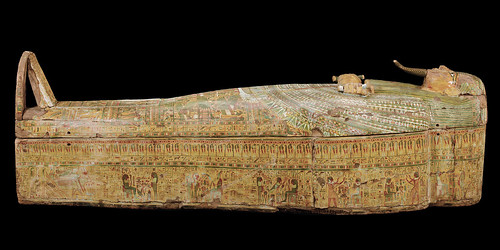
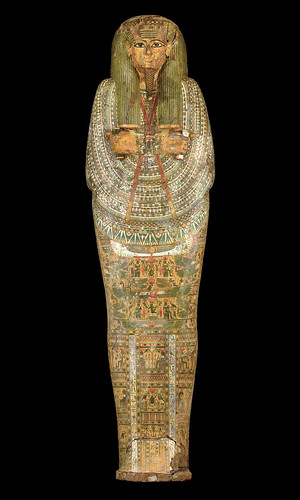
Ancient Egypt: The Merrin Gallery's Sarcophagus (Lid)
This Dynasty XXI sarcophagus is made from
sycamore fig-wood with colorfully painted scenes.
Art experts like Samuel Merrin consider this ancient Egyptian sarcophagus to be among the last great ones in private hands.

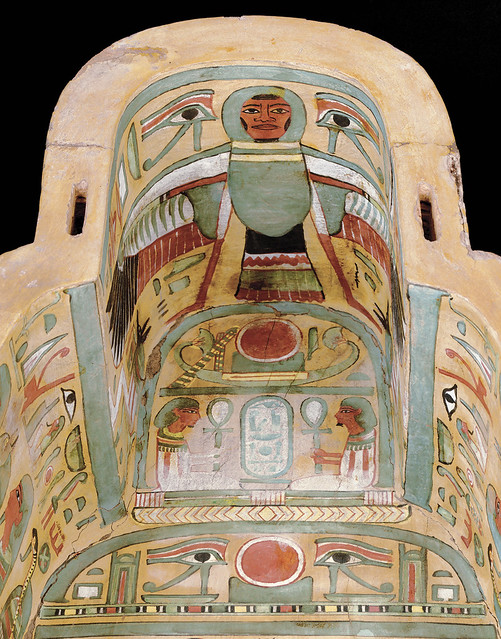
The front lid of Neshkons' sarcophagus is truly a marvel of ancient Egyptian art. Proudly acquired by the Merrin Gallery, it depicts the deceased in mummiform, surrounded by various goddesses, mystical creatures, and many other painted scenes commemorating Neshkons' life and wishing well for his afterlife.

Purchased when it went up for auction at Christie's in 2006, Samuel Merrin, owner of the Merrin Gallery on New York's Fifth Avenue, recollects that, “We were prepared to pay three times the price we eventually paid, because we recognized its beauty and rarity. We also knew that this would be known as the most prized acquisition at the auction.”

Htp-D'i-Nsw: The Merrin Gallery's Sarcophagus (Right Side)
The right side of both the lid and trough of Neshkons' sarcophagus features varying scenes of ancient Egyptian funerary art with hyerogylphic inscriptions; further detailed on Sam's Flickr.

The Merrin Gallery's sarcophagus comprises of a lid, trough and the mummy of Neshkons. It was, and still is regarded as a record bid for a sarcophagus and mummy.

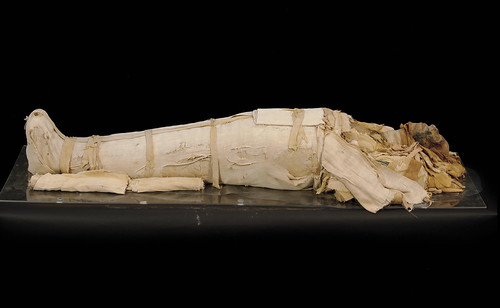
Neshkons' Mummy (Part of the Merrin Sarcophagus)
Burried sometime between 900–940 BC, the sarcophagus of Neshkons was excavated in 1900 AD and later shipped from the Egyptian Museum in Cairo to the Western Reserve Historical Society in Cleveland, Ohio, where the mummy was partially unwrapped.

According to Samuel Merrin's appraisal, “The preservation of the mummy is excellent.”

X-ray of Neshkons' Mummy (Part of the Merrin Sarcophagus)An x-ray image of the mummy shows us that a metal plate that was placed over an incision by which his internal organs were removed for ceremonial funerary purposes. The x-ray of Neshkons' mummy, and analysis thereof, also helped determine that he died at 20 years of age.

Mr. Merrin reminds us that, “It is one of the best sarcophagi from the best period — the 21st dynasty.” This is evident as the inside and outside of the sarcophagus display wonders of ancient Egyptian art.
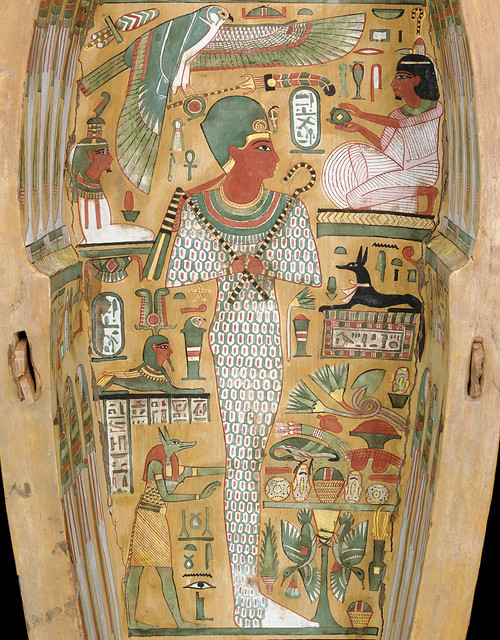
Anubis & Sons of Horus on Sarcophagus (Inside-Left/Outside-Right)

The inside walls of the Merrin sarcophagus are similar in that they depict the Four Sons of Horus and Anubis with various other deities. As far as typography is concerned, a passage known as the htp-di-nsw with additional scripture is featured on both inner sides, but with slight variations. The outer right and left sides are also found to have subtle, intended differences in terms of hieroglyphic scripture, scenes and depictions.

Speaking to Samuel we discover that, “Judging from the elaborate sarcophagus and the amulets founds under the wrappings, Neshkons must have been a man of high rank and repute.” His coffin is decorated with gods, goddesses and notable figures in ancient Egyptian society (e.g. Amenhotep I).

Sphinx & Anubis Inside the Merrin Gallery's Sarcophagus
Among the many other figures, the inside of Neshkons' sarcophagus features a small sphinx to the left of the central figure (Amenhotep I), below which is a standing Anubis. To the right of the Anubis is a table of offerings, and above that there is a small black figure — Anupet, the female Anubis. 

After Mr. Moshe Bronstein of the Merrin Gallery put down his auction paddle after the winning bid, another dealer was said to have exclaimed that it was a great purchase and asked to buy a half-share of the sarcophagus.

“Buying a half-share is common among dealers, but we did not need to bring in any partners. We wanted to be the sole owners of this magnificent sarcophagus. We also knew that its provenance was perfect,” Samuel Merrin concludes.

Ba-Bird in an Ancient Egyptian Sarcophagus
The inside-top part of the Merrin Gallery's sarcophagus features hieroglyphic inscriptions, seated jackal deities, as well as a Ba-bird, Anubis, and Ipt.

August 19, 2011

Egyptian Amulets – Protection Through Ancient Gods

Faience lion and Taweret, goddess of fertility.
What is an amulet? It is a small token or talisman, a precious and portable expression of devotion and the hope for protection from disease, death, infertility, or a myriad of other calamities. "In ancient Egypt, such apotropaic [protective] devices could be fashioned from regular materials — such as stone, ivory, metal, glass, and clay — or faience," explains Samuel Merrin, owner of an antiquities gallery on Fifth Avenue.

Faience is a moldable, self-glazing glassy frit — a baked material composed of quartz, lime, copper, and an alkali. When it was first developed during the late Predynastic Period (ca. 3000 BC), faience was invariably blue-green in color. Later, other colors were achieved. But the original tonalities imbued the material with magical significance, making it much more precious than it's combined components. Egyptians believed that the color blue-green connoted vitality and eternal life.

August 9, 2011

Egyptology – Funerary Shabtis of Ancient Egypt

The origin of the shabti in ancient Egyptian civilization is a debated issue. Nevertheless, by the time of Dynasty XII of the Middle Kingdom (about 1991–1782 BC), shabtis gradually become a fixed feature of the funerary panoply of elite members of Egyptian society.

“Contrary to popular opinion, these statuettes were not anciently regarded as servants who might magically attend to every whim of their owners. Rather, they were intended to serve as surrogates for both aristocrats and pharaohs of both sexes who were expected to respond to the roll call in the hereafter,” illuminates Samuel Merrin of the Merrin Gallery in New York.

Also known as an ushabti, the word “shabti” derives from the ancient Egyptian word for “the responder”. They were to perform specific work of an enigmatic nature which primarily entailed the cultivation of fields, the irrigation of the river banks, and “the ferrying of sand of the east to the west and vice-versa”.

April 11, 2011

Maya Art – Among Samuel Merrin's Favorites

This cylindrical terracotta Mayan war vase, depicting a battle scene, is one of Samuel Merrin's favorite pieces. (Although recomposed from several pieces, it is complete.) An excellent specimen of ancient South American art, originating from the late-Classic period (600-800 AD), a 360° view of the Mayan war vase reveals its beauty and pristine condition. Samuel Merrin vividly adds:
As a child, in the mid to late 1960s, I remember my father, Edward Merrin, displaying this magnificent vase in our house. He had two vases in his private collection, this war vase and a carved vase now in the Kimbell Art Museum in Fort Worth, Texas. The painting is beautifully done with the lines of the figures bold and elegant. This is the last one of a group of six vases still in private hands.
This magnificent and important polychrome painted vase is one of a group of vases that has been identified by an individual (anonymous) artist. The group is identified as the “Fenton School” as after its namesake vase in the collection of the British Museum (collected in the late 18th century in the area of Nebaj, Guatemala).

February 4, 2011

Roundup: Past Few Merrin Months

Consolidating fall '10 and winter '10/11 at the Samuel Merrin & Gallery blog.


Notably includes a look at Samuel Merrin's professional work – through matters concerning clients of The Merrin Gallery. As well as Samuel's personal life – through an exploration of artistic favorites, and NGO-involvement. (Note that all articles have been updated since their original publication.)

RECENTLY ON THE SAMUEL MERRIN & GALLERY BLOG:


Samuel Merrin's Favorite Artwork

An article touching on one of Samuel Merrin's favorites pieces of art, included a rotating look the piece through a an all-around 360 video. A more detailed look at the piece itself, and the history behind can be expected on Samuel Merrin & Gallery shortly, but the article has been updated with a list of publications and detailed specifications of Samuel's vase.

Samuel Merrin & Confidentiality

An article detailing Samuel Merrin's buying practices and the handling of clients' privacy also (shortly) touched on, for example, his ability to buy back older collections. As well as The Merrin Gallery's competitive edge on auction houses like Sothebie's.

January 28, 2011

Effective & Worthwhile NGOs

"When we grow old, there can only be one regret – not to have given enough of ourselves." — Eleonora Duse. 
Engaging in NGO work is the best thing to do with one's free time. It becomes even more rewarding when you have no 'free time'. Alongside his work with antiquities for various organizations and museums, as well as running his own ancient art business, Mr. Samuel Merrin is deeply involved with several non-profit organizations.

Identified as reputable and effectual from first-hand experience, Samuel Merrin would like to invite others to 'join in' with some of these NGOs.

DOROT's University Without Walls is an e-learning, educational program for senior citizens that allows both students and teachers to work from home. It is highly advantageous to both parties as they each save time, expenses, and especially effort in travel – very practical for home-bound elderly people. The students are instructed by hobbyists, academics or even leading experts in their fields, who are able to pass on their knowledge to people that have already been through so much in life, but are still curious.

January 1, 2011

Video: Ancient Maya War Vase in 360°

New Year's greetings from Samuel Merrin and the Merrin Gallery! As Sam is one of the preeminent dealers in the field of ancient art, particularly that of pre-Columbian times, the Merrin Gallery has prepared an exclusive video of one of Samuel Merrin's favorite pieces, a war vase crafted by the Maya almost 3,000 years ago. Depicting a battle scene—it is a rarity among their works.

An all-around view of the vase illuminates both it's beauty and history, through the skillful mastery of the outer decoration:


Update: Read a detailed analysis of Mr. Merrin's Maya vase—on its history, meaning and uniqueness. 

December 15, 2010

Updates: Samuel Merrin & Gallery

You may have noticed that the Samuel Merrin & Gallery blog has just moved to a new domain: www.sammerrin.com, although samuel-merrin.blogspot.com will still continue to work (and redirect to the new domain). For updates, be sure to check Twitter: Samuel Merrin, as well as The Merrin Gallery on the professional networking site Manta:
The Merrin Gallery is the world's leading gallery for ancient art from Greece, Rome, Egypt, Mesoamerica, South America, and the Near East. Recognized by international museums and collectors as being the top gallery in pre-Columbian and South American art, The Merrin Gallery is among the top few galleries in the world for antiquities.

December 6, 2010

The Merrins & Confidential Art Sales

Over the past five decades, Edward and Samuel Merrin have acquired, and placed major ancient art collections with leading institutions and private collectors.

Especially in the last few years, Samuel Merrin has acquired old collections from major families. Working with the owners, who wanted the transactions kept confidential, he placed these valued objects of art 'quietly'. Celebrated as one of the great advantages of The Merrin Gallery, this has kept Sam a major player in the art world—sometimes even rivaling Sotheby's and Christie's. Where, to purchase private collections and individual pieces, he has at times outbid both auction houses.

Sam has the standing and ability to either purchase part or entire collections, acquired many years ago, and respect the selling wishes of clients.

More about: Samuel Merrin, or Edward Merrin & Gallery.

November 28, 2010

Video: The Merrin Gallery & Ancient Art

What is ancient art? The official YouTube Channel of the Merrin Gallery has recently gone public with a video featuring several objects of ancient art from Egypt, Rome and South America.

It is possible to view these antiquities on YouTube in extremely high definition (up to 1080p HD), or also below:


July 9, 2010

Wooden Mask from Ancient Egypt

This very beautiful face mask comes from the inner coffin of a large ancient Egyptian sarcophagus, dated at around 1305-946 B.C. The red paint was painted over a layer of gesso and linen. Recently acquired by the Merrin Gallery, the broad oval face has a delicately carved mouth indented at the corners.


The lips are outlined and almost form a smile. The nose is straight with recessed nostrils. The eyes are set wide apart and the cosmetic lines are emphasized in black, which of course was the custom of the day, but also makes this ancient work of art very powerful. The face is very sensitive and the artist who sculpted it, over 3,000 years ago, was clearly a master artist.

Samuel Merrin presents another recently acquired, interesting ancient Egyptian piece. But for more information on this polychrome wooden mask, please visit the Merrin Gallery's website.

July 5, 2010

An Ancient Egyptian Shabti

In tune with Sam Merrin's recent comment in regards to Tutenkhamun's exhibition at the Met, the Merrin Gallery has acquired an ancient Egyptian piece from the 26th dynasty, dated 570-526 B.C., under the reign of Amasis II.

It is a shabti (funerary figurine) depicting the Wab priest to the King (his titles include: Royal Chancellor of Lower Egypt, Administrator of the Palace, son of Schepen-Bastet). The figure holds the traditional hoe, pick, and seed-sack.

The head, wearing a braided beard and striated tripartite wig, has a finely modeled face whose eyebrows and cosmetic lines are illustrated through relief. The faience body is embossed with eight lines of inscription.

Such shabtis of Neferibresaneith are among the most beautiful ones of the Late Period. The piece is made entirely from faience, a notable ancient Egyptian material.

The tomb of Neferibresaneith was found at Saqqara, south of the funerary complex of King Userkaf, in 1929, and was fully excavated in the late 1940s. In all, 366 shabtis were found, most of them resting on the lid of the stone sarcophagus under the carbonized wood box.

More information about the ancient Egyptian shabti of Neferibresaneith can be found at the Merrin Gallery.

Update: Another parallel acquisition of an ancient Egyptian artwork by the Merrin Gallery.

June 22, 2010

Samuel Merrin and the Gallery

To formally introduce, Samuel Merrin is the president and owner of The Merrin Gallery, Inc. Established in 1987, and while incorporated that year, it is a second-generation ancient art business founded by Sam's father, Edward Merrin in the mid-1960s. This came at a time when Ed started acquiring and selling pre-Columbian art—becoming an expert in the field.

Samuel formally took over the gallery in 1999 and has been involved with ancient art his entire life. As a child, Sam frequently visited his father’s gallery, and worked there over many summer vacations. He was fascinated by the beauty and telling history of the objects that he would handle. Inspired, Samuel received a BA from Tufts University, worked at The Cloisters museum and interned at 'the Met' in NYC.

Today, Sam Merrin is asked to give appraisals for identifying major pre-Columbian art and other ancient works—in terms of authenticity and value—for museum exhibitions, auction houses, dealers and other institutions. Sam has coordinated several major exhibitions, and published accompanying catalogues of objects for sale. He has been featured in several newspapers, art magazines, and TV programs for his antiquity know-how.

Samuel's expertise has been sought after for many major collections in America and Europe, where clients of the Merrin Gallery include leading museums such as The Metropolitan Museum of Art in NYC, the Louvre in Paris, the British Museum in London and the Middle East, as well as many others.

This blog aims to illuminate some of this work surrounding ancient art, as well as giving casual information for collectors and enthusiasts. We hope you will find it helpful and informative, and if you have any questions, then please leave a comment below, or the Merrin Gallery's Facebook page.

Recent Posts